
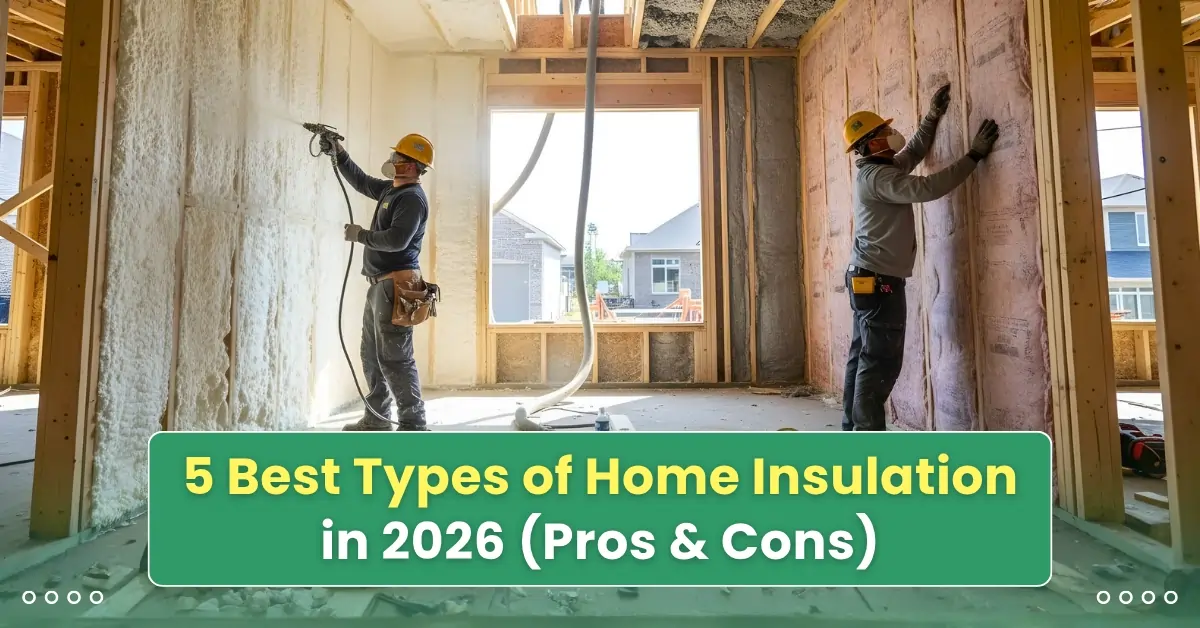
Do you want to learn about different types of insulation for homes? Here, you’ll learn about 5 main types of insulation to choose from. If you’re building a new home or renovating one, insulation is an essential part. It helps control heat flow and maintain a comfortable temperature in different weather conditions. Also, if you’ve been paying high utility bills for a long time, home insulation can help reduce your bill and give you the comfort you were looking for.
Opting for home insulation is a long-term investment that helps you live comfortably for years. One of the benefits of home insulation is that it can help reduce moisture buildup and the risk of mold, and also reduce noise between rooms and from outside. Has your contractor suggested some insulation options, but you want to confirm your choice? Learn the best insulation types for your home and choose the one that suits you best.
1. Fiberglass Insulation
Fiberglass insulation is one of the best and most cost-effective insulations for a house. It is made using fine glass fibers to reduce heat transfer and slow air movement in walls, ceilings, and floors. The fiberglass material is made of fine glass fibers created by melting sand and recycled glass into strands. In the market, fiberglass is available as batts, rolls, and loose-fill to slow air movement so your space stays warm in winter and cool in summer.
Batts and rolls are made to fit between wall studs, floor joists, and ceiling rafters. On the other hand, loose fill is blown into the wall cavities or any area where a harder insulating panel can’t be installed.
Pros:
- It can be installed by homeowners.
- Fiberglass insulation is cost-effective.
- It’s easily available at home improvement stores.
- Installation is very simple.
Cons:
- The fiberglass panels must be cut precisely.
- Over-compressing the material may reduce performance.
- It must be installed correctly and tightly to avoid persistent gaps.
2. Spray Foam Insulation
Spray foam is one of the best insulation options for old houses that involve spraying foam to fill cracks and gaps in building walls, ceilings, and other areas as needed. Spray foam insulation material is prepared by combining two chemicals- polyurethane and isocyanates, which expand significantly after application upon reaction. This allows it to reach even small spaces that general insulation methods can’t target. The combined chemicals in the spray foam create a barrier on the surface and provide consistent insulation to help improve insulation and reduce air leaks in homes.
Pros:
- Highly durable method that protects voids and cracks in your home for decades.
- Prevents moisture and mold formation by adhering to the surface and creating an air leakage barrier.
- Works on noise cancellation by reducing the sound transfer between rooms from the outer environment.
- Provides strength to roofs and walls, ideal for areas with heavy snow or strong winds.
- Helps reduce air leaks, which may limit dust entry.
Cons:
- The upfront installation cost is higher than most traditional insulation options.
- Spray foam insulation can only be done by professionals, as it involves chemicals.
- Installation requires you to stay out of the home for 24-48 hours, as the chemicals may trigger eye irritation and asthma attacks.
- The removal process is costly.
3. Cellulose Insulation
Cellulose insulation has been used for decades and remains very effective and eco-friendly. Its insulating material is prepared by treating recycled paper, cardboard, or newspapers with fire-retardant chemicals. It is usually installed as loose fill or blown into walls and attics, which makes it ideal for new homes and home improvement. The loose-fill material in cellulose insulation is usually installed in floors, walls, and attics to provide protection against noise and heat loss.
Pros:
- It’s an eco-friendly insulating solution as it uses up to 85% recycled materials.
- Lower installation costs, as it is mainly composed of leftover materials.
- It helps prevent moisture and mold buildup.
- Provides soundproofing to prevent noise between rooms in the home.
Cons:
- Cellulose insulation may not be suitable for certain attic spaces.
- It takes time to dry and is time-consuming.
- The cellulose material slowly settles, leading to a reduction in insulation effectiveness.
- Cellulose insulation can absorb moisture, which may increase the risk of mold.
4. Rigid Foam Board Insulation
Rigid foam insulation is composed of lightweight, easy-to-install plastic foam, unlike fiberglass batt insulation. The rigid foam board insulating material consists of three main types of plastics: polyisocyanurate, expanded polystyrene, and extruded polystyrene. All these plastics have different R-values.
An R-value is the measurement of thermal resistance provided by a material. Hence, the higher the R-value, the more heat it resists, making your home more comfortable. Rigid boards are commonly used in mechanical rooms to maintain temperature and to insulate building walls, ceilings, attics, garage doors, basements, and exterior walls. Overall, it is used in both commercial and residential settings to prevent heat loss.
Pros:
- Provide better moisture control by creating a barrier to prevent damage to the building structures.
- The added flame retardants in insulation materials help improve fire resistance in homes.
- Helps reduce heat loss through the structure.
Cons:
- Higher initial cost of installation.
- Professional installation is required to maximize the effectiveness.
- It has a greater impact on the environment because it’s made from petroleum-based materials.
- It may not fit in irregular spaces, unlike fluffy batts and spray foam materials.
5. Mineral Wool Insulation
Mineral wool insulation is considered best for extreme weather conditions. It consists of dense and fibrous material made from rock wool or slag wool. These materials are created by melting natural stone or industrial byproducts and spinning them into fibers. These fibers are then converted into boards, batts, rolls, and loose fill for installation in different areas of a home or commercial building.
Mineral wool insulation is very dense and fiber-based, which makes it highly effective for soundproofing. Hence, it’s commonly used in home theaters, recording studios, apartment buildings, and acoustic panels to absorb sound frequencies that other insulation methods might not capture.
Pros:
- It’s easier to cut and install in the required spaces.
- Offers enhanced sound blocking compared to fiberglass insulation.
- Higher thermal resistance due to a higher R-value.
- Allows tailoring of mineral wool insulation materials during the manufacturing process to provide fire resistance.
Cons:
- Mineral wool insulation is costlier than traditional insulation.
- Mineral wool is dense and heavier and may need additional support.
- It’s not as easily available as other insulating materials.
Also Read:-Home Energy Audit in Albany: What It Is & Why You Need It
Vertesol: Home Insulation Services in Albany, NY
Vertesol provides various types of insulation services for homes in Albany, and we have expertise in spray foam insulation. It’s one of the best insulation methods for targeting air leakage. Spray foam is made from chemicals that expand upon installation, providing better sealing and heat resistance.
We use spray foam insulation in attics and basements that leak cold air and in spaces at risk of moisture and mold formation. We also use insulation in renovation projects; as a result, homeowners experience more consistent temperatures in their homes and greater comfort.
Before installing insulating material, we ask our clients about their concerns. We ask them if they feel the rooms are comfortable or if their energy bills have increased. This helps us identify problems and decide whether spray foam insulation is suitable, as most spaces require other insulation methods. If you want to update your insulation or are building a new home, consider us for professional insulation installation in Albany, NY.
Frequently Asked Questions
Home insulation controls the heat flow into and out of your home to maintain an even temperature. As a result, it helps a home stay warmer in winter and cooler in summer, which reduces energy bills and improves comfort.
Spray foam insulation is widely recognized for its long lifespan as it’s sprayed into the required spaces and adheres to the surface strongly, hardening it. The chemicals involved in spray foam insulation expand and penetrate the gaps and cracks in walls and ceilings to cover even the smallest spaces, which can’t be addressed by other insulation methods.
Rigid foam board is a strong insulation option for walls, floors, and roofs due to its high R-value and ability to withstand moisture. It’s used for high-efficiency insulation in buildings and mechanical spaces.